Showing posts with label Dear Killer. Show all posts

Monday, July 21, 2014

Blog Hop: Why I’m Glad I’m GADD

My thanks to Marni Graff (www.auntiemwrites.com) for inviting me to take part in this blog hop. Marni’s mystery series features Nora Tierney, an American children’s book author living in England. While contemporary, the series honors classic British mystery traditions. The three books published to date also give readers a chance to share the author’s love and detailed knowledge of Great Britain locales. THE BLUE VIRGIN takes place in Oxford and London, while THE GREEN REMAINS and THE SCARLET WENCH provide a loving look at the Lake District. Marni’s books can be found on Amazon.com in trade paperback and ebook formats.
It appears that I have a case of GADD—genre attention deficit disorder. I love to write (and read) traditional who-done-its, romantic suspense, historical thrillers and humorous cozy mysteries. I’ve now published--or have work-in-progress—in all of these genres. This isn’t the smart way to build a fan base. Conventional wisdom says I should focus in one area and build a brand so readers know what to expect when they pick up a novel by Linda Lovely. But my genre-hopping ways help keep my writing fresh, my plotting fun, and my little mind quite busy. Best of all, I enjoy the variety and the unique challenges each literary niche represents.
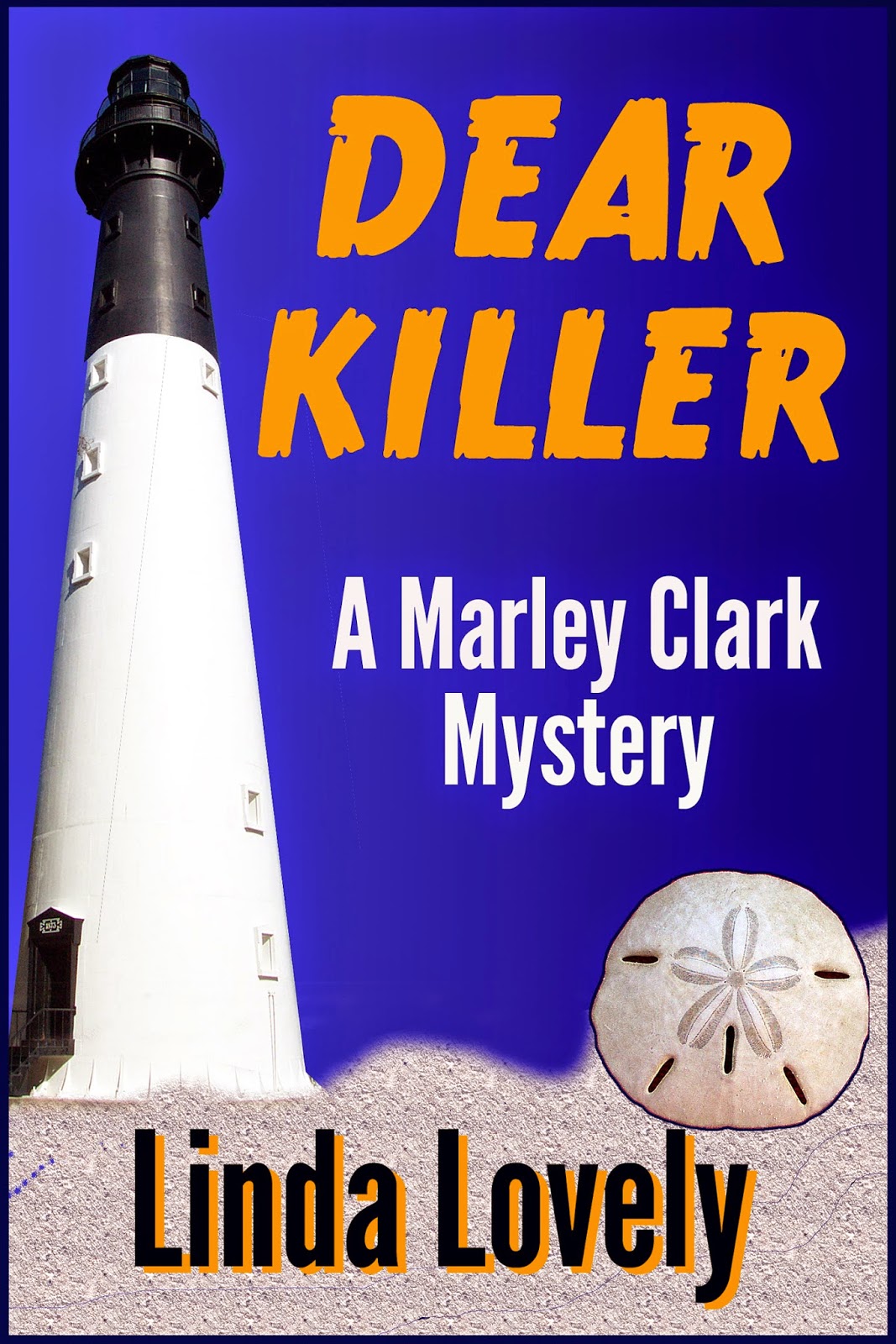
I currently have two series. My Marley Clark MysteriesDEAR KILLER and NO WAKE ZONE—feature a kick-ass, 52-year-old heroine. The widow, a retired military intelligence officer, works part-time as a security guard on a private island in the South Carolina Lowcountry. A third book, WITH NEIGHBORS LIKE THESE, is slated for release late 2014.
My Smart Women, Dumb Luck romantic thriller series follows the action-packed and somewhat steamier adventures of a trio of friends. The three heroines have special skills and knowledge and are jump into the fray to help one another whenever loves, lives or reputations are on the line. DEAD LINE, set in Atlanta and Jamaica, focuses on Nexi Ketts, a forensic accountant. DEAD HUNT features Riley Reid, Director of Security for a university in Upstate South Carolina that’s facing a terrorist threat. DEAD CURE, the third novel, begins when Kate Johnson, a researcher, suspects her mentor may be murdering people for “the greater good.” 
Recently I’ve had a blast working with talented professional narrator, K.C. Cowan on audiobook versions of the novels in these series. DEAR KILLER, NO WAKE ZONE and DEAD LINE are available on Audible.com, iTunes and Amazon. DEAD HUNT will be available late fall.
A journalism major in college, I’ve always made my living as a writer. Over the years, I’ve pretty much written whatever PR and advertising clients paid me to write—newsletters, radio ads, brochures, website copy, speeches, technical help manuals. Now I write what I love—fiction. In addition to the fiction projects listed above, I’ve finished a first draft of an historical thriller set in 1938 as well as plot outlines and opening chapters for four books in a humorous cozy mystery series. I’m keeping busy.  
Oh, and I’m a member of Sisters in Crime, Romance Writers of America, International Thriller Writers, and the South Carolina Writers Workshop (SCWW). I’m also a volunteer staffer for the wildly popular, sold-out Writers’ Police Academy to be held September 4-7, and I’m moderating an audiobook panel at the SCWW Conference in Myrtle Beach, SC, October 24-26.
I’ve tagged Howard Lewis, an invaluable critique partner, to continue this blog hop on July 28th. Howard is the current president of our Upstate SC Chapter of Sisters in Crime and, if you visit his blog, you’ll discover he has a terrific sense of humor. He is currently working on a young adult fantasy. Here’s his blog address: http://howardglewis.wordpress.com/  

Thursday, June 6, 2013

Location, Location—Where To Set Your Story

 By Linda Lovely

SC Lowcountry-Dear Killer Setting
Choosing a setting for your story is more than a matter of window-dressing. It impacts:
  • PLOT: Every location offers a unique cornucopia of potential challenges and resources. In a suspense/ thriller novel, location factors are often tightly woven into the plot fabric. Think Deliverance or Hunger Games. In a romance or drama, the setting’s social milieu influences plot by defining what behaviors are (or are not) acceptable. Think The Help.    
  • CHARACTERS: Setting also plays a role in defining characters—how they think, act, and talk. It would be very difficult to extract New Jersey’s “DNA” from the Stephanie Plum, Janet Evanovich’s loveable character. Even if your heroine is a stranger/newcomer to your setting, how she reacts to the “natives” and their customs will tell the reader a great deal about her character.  
  • MOOD: The scenery and weather peculiar to a location can set the mood throughout a book. Blue skies, oppressive heat, dense fog, numbing cold, tropical downpours, urban decay, unspoiled beaches—these are just a few of the many elements used to signal optimism or foreboding and communicate sadness or happiness.
  • SALES:  While selling books is seldom an author’s prime consideration in selecting a novel’s location, it is worth mentioning. People enjoy reading novels set in their hometowns or in places they’ve visited. Of course, there’s also a danger. Readers may be highly critical if a book’s descriptions fail to match memories or photographs.

I’ve published three books. I followed the “write what you know best” dictate in selecting the locations for both of my Marley Clark Mysteries (Dear Killer and No Wake Zone), set in the South Carolina Lowcountry and Spirit Lake/Okoboji, Iowa, respectively. I have intimate knowledge of both locations—people, geography, history, culture—and could weave key details into my plots.
I changed tactics for my latest romantic thriller, Final Accounting, and set it in Jamaica—an island I’ve only visited. Despite a lack of detailed Jamaican knowledge, I couldn’t resist sending my characters there.
Jamaica is a study in stark contrasts. Paradise and poverty. Lavish resorts and urban violence. Soaring mountains and deep, dark caves. These contrasts give an author everything she could ask for to make setting another character in the story—from fairytale beaches that provide perfect backdrops for a romantic embrace to steep mountain roads where danger seems to lurk around every corner (even when you’re not being chased by a determined assassin).
Though similar contrasts can be found throughout the world (the U.S. included), Jamaica offered my readers a number of exotic and unexpected extras. Many Jamaican tourists never step foot outside all-inclusive, walled resorts. However, my husband and I had the advantage of being shown around the entire island by expert guides—my sister, Rita, and brother-in-law, Hank. They lived in Jamaica for seven years. Hank, an engineer, headed a major highway construction project, and his work took him to virtually every part of the island.
During our visit, we accompanied Hank to a number of locations. On one sojourn we drove into the hinterlands in search of gravel pits. En route, we bought coconuts (but not the ganja/marijuana) offered by roadside entrepreneurs and ate jerk chicken at stands where one hoped the fiery spices killed germs. In Kingston, we marveled at the number of goats and machete-carrying pedestrians holding up traffic. Of course, we also ate at five-star mountain-top restaurants, visited ritzy resorts, and went for an unforgettable evening cruise on Jamaica’s bioluminescent bay.
In Final Accounting, my heroine and hero visit many of these same places. They also descend into Dragon’s Throat, a fictitious cave modeled on real caves in the Cockpit region. Since I’m slightly claustrophobic and don’t like heights, I’m happy to report I didn’t rappel into a mile-deep cavern for a first-hand look. But I did try to capture what my characters experienced. How? Thank heaven for the Internet.
Internet Research, Asking for Local Help
My brother-in-law gave me the idea of using caves in my plot, suggesting they’d be “a great place to hide bodies.” His observation launched me on a research project back home, and I found the Jamaican Caves Organisation (JCO) and Ronald Stefan Stewart, JCO’s founder. After I viewed the JCO’s extensive library of cave exploration videos, I wrote a first draft of my cave scenes and sent them to Stefan for review.
In my experience, individuals like Stefan are more than happy to share their expertise with authors. They’re willing to read relevant scenes to see if physical settings are portrayed correctly and to give their opinion on whether the dialect, dialogue and mannerisms of locals are true to life. Such resources may be just a Google, Tweet, Pinterest or Facebook post away.
In my case, Stefan’s expertise was invaluable. He’s visited more than 250 caves and sinkholes in Jamaica and discovered more than 50 new ones, which he’s added to the nation’s Register. If there are any errors in my descriptions of the fictional Dragon’s Throat cave, caving, or the Cockpit region, rest assured the mistakes are mine. If you have any interest in caving and the JCO’s important conservation initiatives, please visit the JCO website: http://www.jamaicancaves.org/main.htm.

Okoboji, Iowa-No Wake Zone Setting

What my research taught me is that authors don’t have to personally visit every location included in a novel—if they commit to doing the research and asking for help. Writing fiction exercises the imagination.  Taking our characters beyond our own geographic boundaries give us a chance to visit new, exciting worlds. Even if we never leave our computer screens.
How/Where To Find Information
Talking in-person with residents of the selected area is an obvious starting point. However, there are many additional ways to glean information.
·        Contact Chambers of Commerce and search their websites for member organizations that might offer unique insights. Examples run the gamut from historic foundations and B&B owners to deep sea fishing charters and popular restaurants.
·        If your location is a vacation destination, contact travel agents and or local tour guides.
·        Search out and read relevant magazine articles and books (fiction and nonfiction, history and contemporary) for ideas.
·        Scan rosters of professional writer organizations to see if fellow members (or book sellers) reside in the area.
·        Try to establish contact with a librarian at a community or college library.
·        Ask for help on social networks and conduct searches on Google, Facebook, Pinterest and Goodreads.
Research can be half the fun of writing a book. The only danger is that you may get so wrapped up in research you neglect your writing.

Have you written about a place you’ve never visited? Have you read a book that made an unfamiliar location seem so real you felt you’d spent time there? What are your favorite settings for novels?

About the Author: Linda Lovely was a journalism major in college and has always made her living as a writer, working predominately in public relations and advertising. She now focuses on writing stand-alone thrillers and the Marley Clark Mystery Series. For more information, visit her website: www.lindalovely.com.