Showing posts with label Linda Lovely. Show all posts

Monday, October 29, 2018

Halloween Giveaway! Win a PICKED OFF Ebook!


By Linda Lovely

TREAT YOURSELF! 

HALLOWEEN THRILLS AT UDDERLY KIDDING DAIRY

Brie Hooker and her friends have gone all out to create a Haunted Barn that’s the highlight of a Halloween-themed fundraiser at Udderly Kidding Dairy. They’re hoping to fatten the campaign chest of Aunt Eva’s best friend, who’s running for South Carolina governor. Stuck wearing a skimpy mermaid costume her buddy Mollye insists was the only choice, Brie’s costume woes prove the least of her troubles when Udderly’s Haunted Barn becomes the setting for real fright.  

Enter My Halloween Drawing! Giving Away 
3 Ebook Copies of PICKED OFF!
 You can enter by visiting my Facebook page, tweeting a message to @LovelyAuthor, or commenting on this blog post about your best or worst Halloween costume before midnight Wednesday, Oct. 31. No purchase necessary to win. Random drawing will be held Thursday, Nov. 1. 

Would love to hear about your best or worst Halloween costume!


Friday, March 16, 2018

Babies & Books!

By Linda Lovely

My kind of baby shower! Kay Barrett's invitation suggested that attendees who wanted to bring gifts opt for children’s books. No worries about colors or sizes.

But I had one teeny problem with the invitation. It invited us to bring one of our favorite children’s books. Uh oh. Despite the fact that I have no recollection of it, I’m willing to bet Mom read to me. It troubles me sometimes that I have very few memories before about age eight. They say folks afflicted with dementia often can’t remember anything in the present but have great recall of childhood events. If I fall victim to Alzheimer’s, will my mind be totally blank?

When I confessed my lack of early memories to one person, she looked at me with pity.
“You must have had a traumatic childhood,” she said. “You’ve repressed those horrible memories.” Wrong. I’m convinced the opposite is true. My childhood was extremely pleasant and therefore somewhat boring.

Now from we’ll say age eight on, I do have memories. One of them being the bedtime stories Great Aunt Kate told us when Mom was out for the evening and it was her job to tuck my sister and me in. A former English teacher, Aunt Kate decided her memorization of Shakespeare shouldn’t be wasted. So she often recited Macbeth to send us off to dreamland. Actually Aunt Kate acted it out in her nightgown, shadows dancing on the bedroom wall, fake dagger and all. That may explain a lot.
In grade school, I also remember LOTS of books. As a latch key kid, I spent a lot of time at the library. My favorites usually included horses and distant lands. I remember the first time I saw a fjord pictured in a book. It was about the coolest thing a kid who lived in Iowa could imagine.

But, I digress. Back to the baby shower.  Before venturing to a local bookstore in search of a cool baby or children’s book, I chatted with several of the other folks who’d be attending.  In doing so, I think I discovered why I couldn’t recall any children’s books. As mothers, they’d all read books to their children. So their favorites were ones they’d loved sharing with their kids. Since we never had children, I’d not had that experience though I like to think I’d have been a big reader if I’d had little ones to tuck in bed.

Anyway, I had great fun looking through options at Fiction Addiction, an independent bookstore in Greenville, South Carolina. Since I’d already heard several friends mention the titles of children’s books that had been staples for generations, I decided to pick some new additions. The ones I chose actually were made of non-toxic materials that kids could chew on, giving new meaning to the phrase ‘eat your words.’ You could even wash them. Cool. And the illustrations were sweet and full of life and color.

I’m sure once Louise Barrett arrives in the world, she will have a wonderful time reading with her parents, Jesse and Lisa. Welcome to a wonderful world of books.

Friday, August 18, 2017

Rita the Mule

By Howard Lewis
Critique Partner Extraordinaire & Mule Owner

I feel the need to write on behalf of the mule, Rita. Somebody has to support her because she has a bone to pick. The mule doesn’t get near enough respect in Linda’s book.
You see, Rita’s not just some other animal. She’s a hybrid. Her mamma’s a horse, and her daddy’s a donkey. Receiving the best from each, she knows she’s better than either.
This means that she’s braver than donkeys and smarter than horses. Her intelligence is why some people consider her stubborn, but it’s pretty simple. If it doesn’t make sense to Rita, she won’t do it. Before she came to live with Lilly, her human sent her to a local horse trainer with 25 years
of experience and a great reputation. Rita had a lot of fun with him before he gave her back saying, “Mules are different.” The trainer was used to pestering horses into doing what he wanted. It didn’t work with Rita. Of course, once she got Lilly trained, she gave in a lot so she could spend time with her human.
Rita loved Lilly. This human made her feel like a friend instead of a servant. Rita grieved terribly when she lost Lilly. Unfortunately, when Brie met her, the mule wasn’t in the mood to meet another human. The first time Brie tried to put Rita in the trailer, she led the mule up as if she were a horse and asked her to climb in. Rita’s not a horse so she just stood there. Brie pulled on the lead, offered her a treat and slapped her on the butt. Rita just stood there. Brie stamped her feet and screamed her cheese curses. Rita just stood there. Eva finally said something to her. Brie rubbed Rita’s nose, hugged her face, and told her she was most beautiful mule in the world. Rita walked into the trailer.
Around the farm, Rita lets Hank, Eva’s horse, be boss. It’s not that she couldn’t whup him. Of course she could. It’s just that being boss isn’t as important to her as it is to him. Even though she lets him think he’s the leader, she does take great pleasure picking on him. She’ll creep up beside him while he’s grazing so he has to chase her off. When he’s on the other side of a fence, she’ll walk close enough to make him mad but far enough away so he can’t touch her. When in the barn, she’ll pee right next to his stall so he has to smell it.
Just like all equines (horses, mules, donkeys, zebras, etc.) Rita’s a prey animal. Other animals want to hunt and eat her. Unlike those stupid horses who always run away, sometimes Rita wants to fight. Especially if she’s mad. With a half a ton of muscle and bone, a quick, intelligent mind, and a tenacity that won’t quit, she’s never lost a fight.
The mule has an impressive heritage. Rita can do anything horses can do: drag plows, pull carriages or even carry people in saddles. George Washington believed that her kind were better workers than horses and wanted one. Being a picky man, he wanted a mule sired by a Spanish donkey, considered to be the superior asses of the time. After spending years trying to procure the donkey, King Charles III sent him two. Only one survived the trip. George immediately put him to work breeding a series of donkeys and mules. George even rented him out for stud running
newspaper ads describing his outstanding qualities. Mares and Jennies lined up for his service.
Rita and her brothers are sterile. It has to do with chromosomes. People have a standard set of questions when they discover this. Mostly dealing with Rita’s sex. Yes, Rita has brothers and sisters. Yes, even though she can’t reproduce, Rita goes into heat and her brothers want to have sex. Yes, most of the time, Rita’s brothers are “cut” or fixed. There’s no reason to keep them intact if they can’t have babies and removing certain male parts make them much easier to deal with.
Rita knows she’s beautiful, but she was made for function as well. She has a longer face, than horses and her eyes are further around her head. With just a small movement, she can see behind her with one eye and in front of her with the other at the same time. Rita has huge ears that she can independently turn toward whatever she’s listened to. While her right ear listens to her rider, she can turn her left ear to listen to whatever’s up ahead. 
Have I made it clear yet that Rita’s right? She deserves a bigger part in Linda’s book. Let’s start a campaign. Readers for Rita. Give Rita the Part She Deserves. Rita for President.

About the Author
Howard Lewis is a talented writer, martial artist, and a marvelous critique partner. He lives in the "suburbs" of Salem, SC, with a mule, two horses, and multiple dogs. He's the past president of the Upstate Chapter of Sisters in Crime and he's part of the Writers' Police Academy "family." He's provided tons of information on his equines for my new Brie Hooker Mystery series published by Henery Press. The first book, BONES TO PICK, is now available for preorder. THANKS Howard!  

Wednesday, August 2, 2017

Writers Beware--Kill An Animal, Risk a Reader

By Linda Lovely

I promise. No dogs (or horses or cats or mules or goats or pigs) will cross over the rainbow bridge in my new Brie Hooker mystery series. The easiest way for an author to offend (and lose) readers is to allow a character in her book to kill an animal. Well, maybe a poisonous snake would be okay, and, if you're Stephen King you can cast a rabid dog as a villain as he did in Cujo.

As an adult, I developed serious allergies to dogs and cats. So I haven’t had a really close relationship with a pet since Brownie, the Heinz 57 mix dog I loved as a kid. In adulthood, I’ve been bitten by a dog while walking and minding my own business. I’ve also been chased by growling hounds who appear to lust after bicycle tires. These encounters led me to make one of my animal characters a villain in Dead Line, the first book in my Smart Women, Dumb Luck romantic thriller series. The villain dog died.

In my defense, the deceased canine is the villain in a brief subplot, essential in providing insight into the snarling attack dog’s far more villainous owner. What’s more, the subplot also features a tail-wagging hero dog who saves my heroine. Any further explanation could act as a plot spoiler. So here’s what these two dogs might say if they could talk.   

  • The Villain Dog
I’m only following orders. I was abused as a puppy, and I was trained to fight other dogs. When I growl and savage other dogs, people cheer, and I get food and praise. I’ve been chained up and beaten. I do what I’ve been trained to do in order to survive.  

  • The Hero Dog
I love people. Haven’t really met one I wouldn’t lick. They scratch behind my ears, give me yummy treats, and help rid me of annoying fleas. Sometimes they talk baby talk to me even though I’m fully grown. Guess they still think of me as a puppy even though I’m a hard-working adult. Don’t I chase all those obnoxious squeaky squirrels out of our yard? I’m brave, too. I’ll do whatever it takes to keep my humans safe.

Okay, I’ve given my dog characters a say they didn’t get in Dead Line since they weren't afforded speaking parts. Nonetheless, I renew my pledge to avoid any future canine (or other animal) deaths in my books. I’ll stick to killing off literary stand-ins for the people who have seriously annoyed me.

So readers why is it that mystery/suspense/thriller authors can kill kindly, wrinkled grandmothers and clueless, fresh-faced teenagers as often as their plots and murder counts require, but they should never, never, ever kill a dog on the page of a novel?

Why do you think the death of a fictional animal seems more offensive to many mystery readers than the death of a fictional human being?  Like the villain dog in Dead Line, human villains also may have been abused in their youth and rewarded for bad behavior, but we can handle their deaths. Is it because dog is man’s best friend and we have an emotional bond with the species? Is it because humans are supposed to be the protectors of helpless animals? What’s your opinion?


Friday, July 21, 2017

Pigs Don't Sweat, Authors Do!

By Linda Lovely
My Brie Hooker Mysteries are set on a Udderly Kidding Dairy in Upstate South Carolina. The farm's 400 goats and animal menagerie often figure in the plot. In BONES TO PICK, the first book in the series (debuting Oct. 24), Tammy the Pig roots up a buried skull and with it lots of deadly secrets.
In BONES TO PICK, Tammy is a pot-bellied pig adopted by Aunt Eva after her original owners abandoned her. As Udderly's veterinarian laments, too many people buy pot-bellied pigs as pets when they're cute babies but lose interest when they grow.
So what is a pot-bellied pig and how big do they get? While the breed is considered "small," the average adult weighs about 150 pounds. Yet because it's so dense, a pig of this size would be much smaller than an 80-pound German Shepherd. And Tammy would be a dwarf compared to her farm hog cousins that can weigh in at 900 pounds. Long prized in Vietnam as a symbol of happiness, satiety and wealth, the once plentiful breed was put on an "endangered" list in the 1970s in its native habitat. It was marketed as a pet in the US during the 1980s. Purebred potbellies were black and heavily wrinkled with sway backs sagging bellies.
What's Tammy's temperament?
She's very smart. Pigs are considered  earth’s fourth smartest animal group just behind apes and chimps, whales and dolphins, and humans. Sorry, dogs. Potbellied pigs are not only intelligent, they're curious and have distinct, charming personalities. They can be taught tricks but they have an independent streak. While they can be housebroken, Tammy is an outdoor pig. (They will not soil their water source.) Affectionate creatures, they usually get along well with dogs and cats. 

Pigs Don't Sweat
At age three, Tammy is still a youngster. However, she can expect to reach a ripe old age of 15. Like my vegan heroine, Brie, she enjoys fresh fruits and vegetables and needs to have clean water always available. That's because Tammy, like all her pig relatives, doesn't sweat. So she needs the water to cool off. 

Rooting is a natural instinct and how pigs find food in nature. Tammy loves toys. Like her brethern, she's susceptible to Porcine Stress syndrome, e.g. "freaking" out. But Udderly's vet knows how to calm her down.

Authors Sweat
When I was a kid, I spent a great deal of time on my cousin's farm and helped feed the hogs. But I'm no expert on pigs in general or potbellied pigs in particular. That means that I may have made more than one mistake in my portrayal of Tammy. As an author, I do try to get the details right. But I hope Tammy will forgive me if I made a mistake.

Do you enjoy reading books that include animals?  

Wednesday, July 19, 2017

Write What You Fear?


 By Linda Lovely

We’ve all heard the old saw—write what you know. Oh, really?

Fortunately, most authors of mysteries, thrillers, and romantic suspense have never been shot, beaten, handcuffed, kidnapped, stalked or targeted by a relentless assassin. So does that mean we can’t write about heroines and heroes thrown into terrifying situations?

I couldn't do this!
Of course not. There is a way to write what we “know” when we place our heroines/heroes in dangerous situations we’ve never experienced. Method actors do it all the time. They draw on the real emotions that gripped them at some point in their lives.

I suffer from “moderate” vertigo and a fear of heights. Years ago, when I was a partner in a PR firm that prepared feature articles for corporate clients, I covered the Miss Universe contest for a computerized lighting equipment manufacturer. The client requested photos (I was both writer and photographer) taken from “above” its overhead lights to spotlight its equipment with the Miss Universe contestants on the stage below. To get the shots, I was allowed to climb the scaffolding during rehearsals. (Did I mention this contest was NOT held in the USA where OSHA standards might apply?)

As I scooted along the beam, the whole rickety structure seemed to sway. I was terrified. Sweat beaded on my forehead. My heart raced. My fingers were so sweaty I could barely focus the camera. I got dizzy. Closed my eyes. Tried to steady my breathing. I watched a sweat droplet plummet and wondered if the lady below thought there was a leak in the roof. The incongruous thought made me want to giggle. Edge of hysteria? Maybe.
I climbed to the top of this lighthouse to take
pix for a client. As high as I go & not thrilled. 

My seventh book, Bones To Pick, a humorous mystery, will debut in October. The plots are quite different. But—what a surprise—my heroines all suffer from vertigo and a fear of heights and often find themselves in situations where they must overcome those fears to survive.

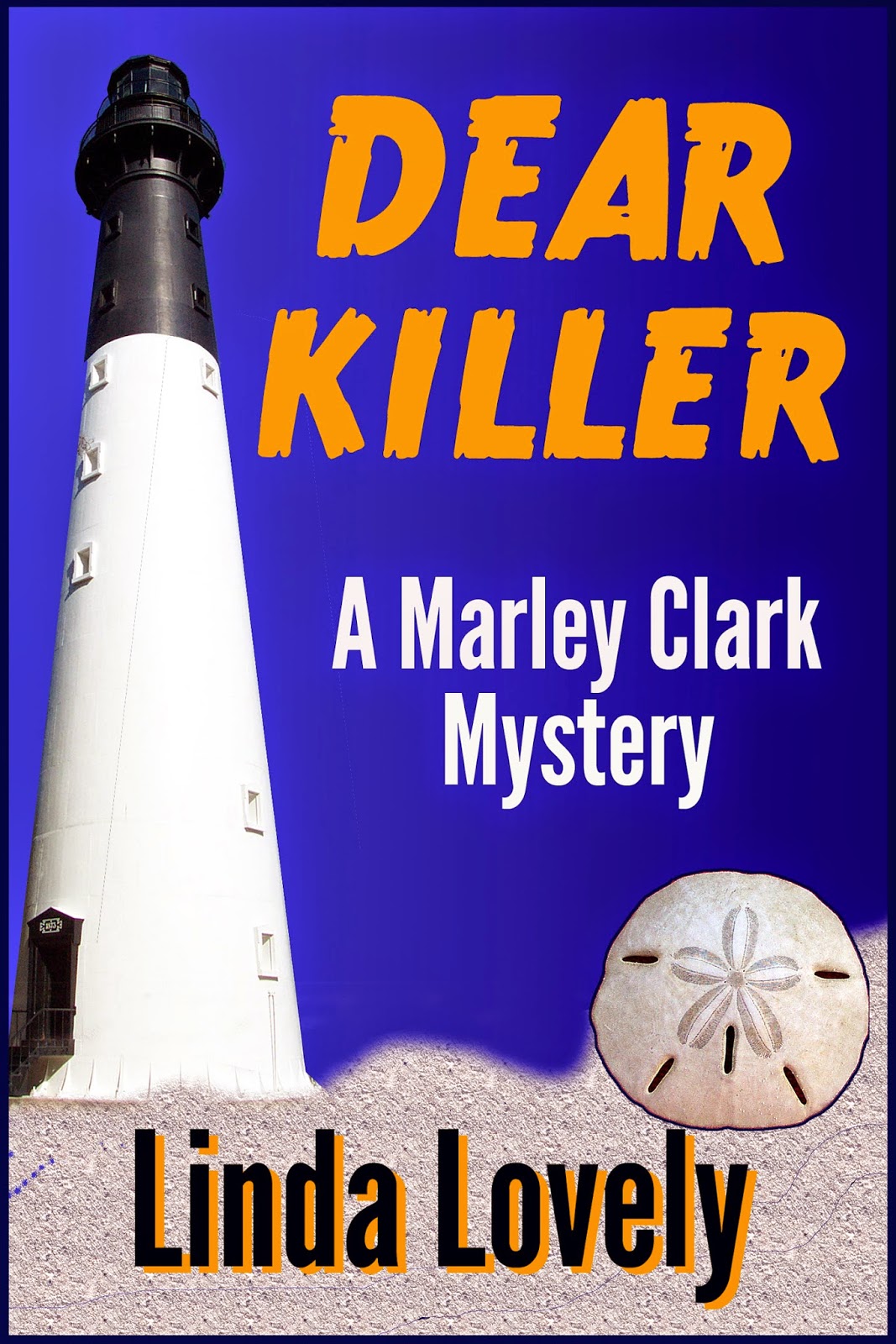
In Dear Killer, Marley Clark climbs to the pinnacle of a lighthouse to flee a gunman. In No Wake Zone, the sequel to Dear Killer, Marley must leap from a rooftop to the scaffolding of a roller coaster to lure a killer away from her cousin. In Dead Line, the first of my Smart Women, Dumb Luck Romantic Thrillers, Nexi Ketts rappels into the depths of a cave that’s deeper than the Statue of Liberty is tall.

Do you take advantage of your fears and remembered emotions when you write? If so, do you have fears that resurface in different guises in your manuscripts?
   

Wednesday, July 5, 2017

Always Ask-Research The Fun Way

By Linda Lovely

The Internet has given authors tremendous new research tools. We can Google almost any topic and find a wealth of materials and information, though it pays to do some vetting to make sure the sources we’re tapping are reliable.

YouTube gives authors a visual/audio window that lets us witness everything from Billy goats in rut to lessons for beginners who want to fly drones. These are actual examples of how YouTube helped me craft scenes in my second Brie Hooker Mystery, my current work in progress.

However, there’s still no substitute for speaking directly with experts. I was journalism major in college and have spent the bulk of my career interviewing individuals for (nonfiction) feature articles. So I’m quite comfortable asking folks questions about their work and themselves. I realize some authors are shy and feel they may be imposing if they ask strangers to spend time answering their questions. Yet most people are flattered rather than annoyed and enjoy talking about their work and themselves. In fact, I can’t ever recall being rebuffed by a single information “source.” Of course, that’s also because I make it clear why I want the information and how I plan to use it. Now that I’m writing fiction, that simply means I’ll be using their experiences and insights to help build more interesting, well-rounded characters and more credible plots.

For BONES TO PICK, my first Brie Hooker Mystery, my interviews included in-person visits to goat farms and breweries (what a hardship). This gave me an opportunity to ask the owners a variety of questions. I also got to taste goat cheese and fudge, and, of course, sample moonshine. Visiting locations helps you visualize potential scenes and also provides ideas about situations and activities for your characters.  Joining a goat yoga class was a true adventure!

So how do you find experts if you want information related to law enforcement topic? 

Even authors of cozy mysteries should try to be as accurate as possible in describing law enforcement and legal procedures, forensics, investigative techniques, etc. I’ve found attending my local Sisters in Crime chapter’s monthly meetings and the phenomenal annual Writers’ Police Academy have been treasure troves of information—and contacts. 

Through these organizations I’ve met everyone from FBI, ATF and Treasury agents to paramedics, coroners, detectives and defense attorneys. What’s more, since we've met, I’m not a stranger calling \out of the blue. We have a prior connection and they know my request is legitimate.

If you don’t know an answer, ask! Not only may you be surprised by the answer, you may find answers to questions you didn’t even know you should ask. Conversations can be a wonderful adventure.


Wednesday, June 21, 2017

A 200-Word Gem—Write It and Cash In

I don’t write short stories. I’d rather write a complete chapter than a 200-word story. My husband will testify that I can’t answer a simple question in less than 200 words.
But I DO appreciate short stories. And, for the last several years, one of my responsibilities as a veteran Writers’ Police Academy (WPA) volunteer has been to line up reader judges for the Golden Donut Short Story contest. Another of my duties is to count the words in each story—to make certain they contain EXACTLY 200 words, including the required title.
Here's a man who knows how to make words count! Craig Johnson,
author of the Longmire series, and this year's contest judge.
The exact word count is a unique contest rule that writers (can you believe it) sometimes fail. Hey, how many of us were math majors or big on following a rule book? Nonetheless there are big rewards for short story authors who can tell a riveting tale in exactly 200 words. The winner of this year’s Golden Donut contest not only receives a nifty trophy and lots of recognition—online and at the WPA banquet—but also gets a FREE registration to a 2018 WPA event. And, guess who's the final judge for this year's Golden Donut contest? Craig Johnson, author of the Longmire series. 
It’s been a pleasure to read the Golden Donut entries in past years. They’ve ranged from funny to spine-tingling, melancholy to horrifying. It’s amazing how a single photo can spark such different tales. The rules of the contest are simple. The contest photo absolutely MUST be the main focus of the story, not just a mere mention within the text. Here’s the inspirational photo for the 2017 contest:
And the good news? There’s still time to enter! The deadline for entries is July 2. Plenty of time to pen 200 words. And you don’t have to be registered to attend the 2017 Writers’ Police Academy to enter. The contest is open to all. Here’s the link to all the details: http://www.writerspoliceacademy.com/short-story-contest/
And don’t forget I’ll be COUNTING on you…

Good luck!

Monday, July 21, 2014

Blog Hop: Why I’m Glad I’m GADD

My thanks to Marni Graff (www.auntiemwrites.com) for inviting me to take part in this blog hop. Marni’s mystery series features Nora Tierney, an American children’s book author living in England. While contemporary, the series honors classic British mystery traditions. The three books published to date also give readers a chance to share the author’s love and detailed knowledge of Great Britain locales. THE BLUE VIRGIN takes place in Oxford and London, while THE GREEN REMAINS and THE SCARLET WENCH provide a loving look at the Lake District. Marni’s books can be found on Amazon.com in trade paperback and ebook formats.
It appears that I have a case of GADD—genre attention deficit disorder. I love to write (and read) traditional who-done-its, romantic suspense, historical thrillers and humorous cozy mysteries. I’ve now published--or have work-in-progress—in all of these genres. This isn’t the smart way to build a fan base. Conventional wisdom says I should focus in one area and build a brand so readers know what to expect when they pick up a novel by Linda Lovely. But my genre-hopping ways help keep my writing fresh, my plotting fun, and my little mind quite busy. Best of all, I enjoy the variety and the unique challenges each literary niche represents.
I currently have two series. My Marley Clark MysteriesDEAR KILLER and NO WAKE ZONE—feature a kick-ass, 52-year-old heroine. The widow, a retired military intelligence officer, works part-time as a security guard on a private island in the South Carolina Lowcountry. A third book, WITH NEIGHBORS LIKE THESE, is slated for release late 2014.
My Smart Women, Dumb Luck romantic thriller series follows the action-packed and somewhat steamier adventures of a trio of friends. The three heroines have special skills and knowledge and are jump into the fray to help one another whenever loves, lives or reputations are on the line. DEAD LINE, set in Atlanta and Jamaica, focuses on Nexi Ketts, a forensic accountant. DEAD HUNT features Riley Reid, Director of Security for a university in Upstate South Carolina that’s facing a terrorist threat. DEAD CURE, the third novel, begins when Kate Johnson, a researcher, suspects her mentor may be murdering people for “the greater good.” 
Recently I’ve had a blast working with talented professional narrator, K.C. Cowan on audiobook versions of the novels in these series. DEAR KILLER, NO WAKE ZONE and DEAD LINE are available on Audible.com, iTunes and Amazon. DEAD HUNT will be available late fall.
A journalism major in college, I’ve always made my living as a writer. Over the years, I’ve pretty much written whatever PR and advertising clients paid me to write—newsletters, radio ads, brochures, website copy, speeches, technical help manuals. Now I write what I love—fiction. In addition to the fiction projects listed above, I’ve finished a first draft of an historical thriller set in 1938 as well as plot outlines and opening chapters for four books in a humorous cozy mystery series. I’m keeping busy.  
Oh, and I’m a member of Sisters in Crime, Romance Writers of America, International Thriller Writers, and the South Carolina Writers Workshop (SCWW). I’m also a volunteer staffer for the wildly popular, sold-out Writers’ Police Academy to be held September 4-7, and I’m moderating an audiobook panel at the SCWW Conference in Myrtle Beach, SC, October 24-26.
I’ve tagged Howard Lewis, an invaluable critique partner, to continue this blog hop on July 28th. Howard is the current president of our Upstate SC Chapter of Sisters in Crime and, if you visit his blog, you’ll discover he has a terrific sense of humor. He is currently working on a young adult fantasy. Here’s his blog address: http://howardglewis.wordpress.com/  

Thursday, June 6, 2013

Location, Location—Where To Set Your Story

 By Linda Lovely

SC Lowcountry-Dear Killer Setting
Choosing a setting for your story is more than a matter of window-dressing. It impacts:
  • PLOT: Every location offers a unique cornucopia of potential challenges and resources. In a suspense/ thriller novel, location factors are often tightly woven into the plot fabric. Think Deliverance or Hunger Games. In a romance or drama, the setting’s social milieu influences plot by defining what behaviors are (or are not) acceptable. Think The Help.    
  • CHARACTERS: Setting also plays a role in defining characters—how they think, act, and talk. It would be very difficult to extract New Jersey’s “DNA” from the Stephanie Plum, Janet Evanovich’s loveable character. Even if your heroine is a stranger/newcomer to your setting, how she reacts to the “natives” and their customs will tell the reader a great deal about her character.  
  • MOOD: The scenery and weather peculiar to a location can set the mood throughout a book. Blue skies, oppressive heat, dense fog, numbing cold, tropical downpours, urban decay, unspoiled beaches—these are just a few of the many elements used to signal optimism or foreboding and communicate sadness or happiness.
  • SALES:  While selling books is seldom an author’s prime consideration in selecting a novel’s location, it is worth mentioning. People enjoy reading novels set in their hometowns or in places they’ve visited. Of course, there’s also a danger. Readers may be highly critical if a book’s descriptions fail to match memories or photographs.

I’ve published three books. I followed the “write what you know best” dictate in selecting the locations for both of my Marley Clark Mysteries (Dear Killer and No Wake Zone), set in the South Carolina Lowcountry and Spirit Lake/Okoboji, Iowa, respectively. I have intimate knowledge of both locations—people, geography, history, culture—and could weave key details into my plots.
I changed tactics for my latest romantic thriller, Final Accounting, and set it in Jamaica—an island I’ve only visited. Despite a lack of detailed Jamaican knowledge, I couldn’t resist sending my characters there.
Jamaica is a study in stark contrasts. Paradise and poverty. Lavish resorts and urban violence. Soaring mountains and deep, dark caves. These contrasts give an author everything she could ask for to make setting another character in the story—from fairytale beaches that provide perfect backdrops for a romantic embrace to steep mountain roads where danger seems to lurk around every corner (even when you’re not being chased by a determined assassin).
Though similar contrasts can be found throughout the world (the U.S. included), Jamaica offered my readers a number of exotic and unexpected extras. Many Jamaican tourists never step foot outside all-inclusive, walled resorts. However, my husband and I had the advantage of being shown around the entire island by expert guides—my sister, Rita, and brother-in-law, Hank. They lived in Jamaica for seven years. Hank, an engineer, headed a major highway construction project, and his work took him to virtually every part of the island.
During our visit, we accompanied Hank to a number of locations. On one sojourn we drove into the hinterlands in search of gravel pits. En route, we bought coconuts (but not the ganja/marijuana) offered by roadside entrepreneurs and ate jerk chicken at stands where one hoped the fiery spices killed germs. In Kingston, we marveled at the number of goats and machete-carrying pedestrians holding up traffic. Of course, we also ate at five-star mountain-top restaurants, visited ritzy resorts, and went for an unforgettable evening cruise on Jamaica’s bioluminescent bay.
In Final Accounting, my heroine and hero visit many of these same places. They also descend into Dragon’s Throat, a fictitious cave modeled on real caves in the Cockpit region. Since I’m slightly claustrophobic and don’t like heights, I’m happy to report I didn’t rappel into a mile-deep cavern for a first-hand look. But I did try to capture what my characters experienced. How? Thank heaven for the Internet.
Internet Research, Asking for Local Help
My brother-in-law gave me the idea of using caves in my plot, suggesting they’d be “a great place to hide bodies.” His observation launched me on a research project back home, and I found the Jamaican Caves Organisation (JCO) and Ronald Stefan Stewart, JCO’s founder. After I viewed the JCO’s extensive library of cave exploration videos, I wrote a first draft of my cave scenes and sent them to Stefan for review.
In my experience, individuals like Stefan are more than happy to share their expertise with authors. They’re willing to read relevant scenes to see if physical settings are portrayed correctly and to give their opinion on whether the dialect, dialogue and mannerisms of locals are true to life. Such resources may be just a Google, Tweet, Pinterest or Facebook post away.
In my case, Stefan’s expertise was invaluable. He’s visited more than 250 caves and sinkholes in Jamaica and discovered more than 50 new ones, which he’s added to the nation’s Register. If there are any errors in my descriptions of the fictional Dragon’s Throat cave, caving, or the Cockpit region, rest assured the mistakes are mine. If you have any interest in caving and the JCO’s important conservation initiatives, please visit the JCO website: http://www.jamaicancaves.org/main.htm.

Okoboji, Iowa-No Wake Zone Setting

What my research taught me is that authors don’t have to personally visit every location included in a novel—if they commit to doing the research and asking for help. Writing fiction exercises the imagination.  Taking our characters beyond our own geographic boundaries give us a chance to visit new, exciting worlds. Even if we never leave our computer screens.
How/Where To Find Information
Talking in-person with residents of the selected area is an obvious starting point. However, there are many additional ways to glean information.
·        Contact Chambers of Commerce and search their websites for member organizations that might offer unique insights. Examples run the gamut from historic foundations and B&B owners to deep sea fishing charters and popular restaurants.
·        If your location is a vacation destination, contact travel agents and or local tour guides.
·        Search out and read relevant magazine articles and books (fiction and nonfiction, history and contemporary) for ideas.
·        Scan rosters of professional writer organizations to see if fellow members (or book sellers) reside in the area.
·        Try to establish contact with a librarian at a community or college library.
·        Ask for help on social networks and conduct searches on Google, Facebook, Pinterest and Goodreads.
Research can be half the fun of writing a book. The only danger is that you may get so wrapped up in research you neglect your writing.

Have you written about a place you’ve never visited? Have you read a book that made an unfamiliar location seem so real you felt you’d spent time there? What are your favorite settings for novels?

About the Author: Linda Lovely was a journalism major in college and has always made her living as a writer, working predominately in public relations and advertising. She now focuses on writing stand-alone thrillers and the Marley Clark Mystery Series. For more information, visit her website: www.lindalovely.com.